Qelvorynax
Cipher Archive
Cipher Archive
Couldn't load pickup availability
Share
1. Problem Statement
As Swift projects grow, learners may find it difficult to keep data movement, task timing, and component responsibilities organized. A structure that works for a small exercise can become unclear when several files, models, and actions are connected. Repeated code may appear across different sections, while changes in one component may unexpectedly affect another. Tasks that do not finish immediately can also introduce timing issues and unclear state changes. Learners need a structured method for coordinating these elements without placing all logic inside one large component.
2. Solution
Cipher Archive presents techniques for separating data, logic, communication, and task states into focused sections. Learners examine reusable patterns that help components exchange information in a predictable way. Each topic is introduced through explanations, code examples, guided exercises, and review prompts. The materials demonstrate how to represent changing states and respond to delayed operations. A final project connects the course topics within one organized information-processing system.
3. What’s Inside
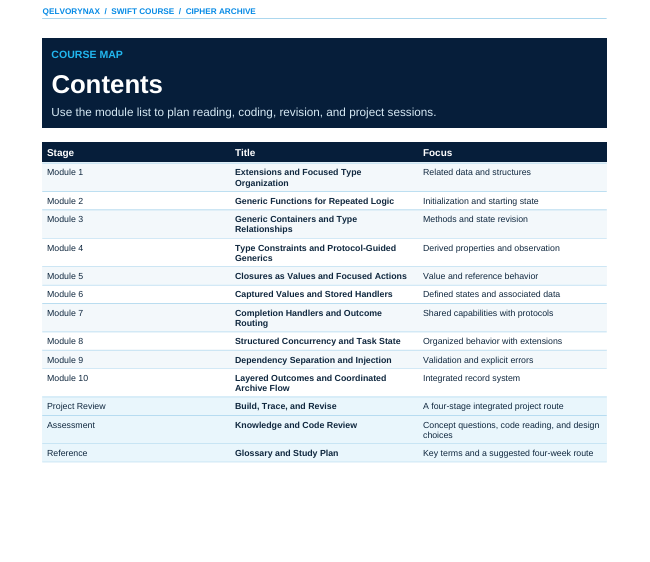
The course opens with a review of custom structures, reference-based models, protocols, and error handling. Learners examine how these concepts can work together when several components share related responsibilities. Early exercises focus on identifying sections that can be separated, reused, or described through shared requirements.
A module on extensions demonstrates how additional behavior can be organized without placing every method inside the original declaration. Learners create focused extensions for formatting, calculations, data checks, and shared protocol behavior. The lessons also discuss naming and file organization so related code remains clear.
The generics section introduces reusable functions and structures that can work with several data types. Learners study type parameters, constraints, and protocol-based requirements. Guided activities include reusable containers, comparison tools, filtering helpers, and result wrappers.
Cipher Archive then explores closures and function-based communication. Learners review closure syntax, captured values, completion handlers, and stored actions. Examples show how one component can send a result or event to another without becoming closely tied to its internal structure.
A dedicated module covers asynchronous tasks. Learners examine how delayed operations begin, pause, finish, and report errors. The materials introduce clear task states such as idle, active, completed, and failed. Exercises focus on updating data only when an operation reaches the appropriate stage.
The course also presents dependency separation. Learners practise passing required services or data providers into a component rather than creating every dependency internally. This approach is demonstrated through storage, validation, formatting, and information-retrieval examples.
Another section covers result modeling and layered error handling. Learners create clear outcomes for valid data, missing information, invalid entries, and failed operations. Review tasks explore how error messages can remain informative without mixing user-facing text with internal logic.
The closing project involves building an organized archive system. Learners define record models, create reusable containers, separate validation and storage responsibilities, process delayed actions, and report task states. A final checklist examines structure, communication, naming, error paths, and repeated code.
4. Who Is This For?
Cipher Archive is intended for learners who already work comfortably with Swift functions, collections, custom structures, protocols, enumerations, and error handling. It suits learners moving toward larger projects where several components exchange information. The course may also help learners who want to revise generics, closures, asynchronous tasks, and dependency separation through connected practice.
5. What You’ll Learn
- Organize additional behavior with extensions
- Create reusable generic functions and structures
- Apply type constraints to reusable code
- Use closures for component communication
- Work with captured values and completion handlers
- Represent asynchronous task states clearly
- Handle delayed operations and related errors
- Separate dependencies from internal component logic
- Model valid and invalid outcomes
- Divide storage, validation, and formatting responsibilities
- Reduce close coupling between components
- Review larger code structures for clarity
6. 30-Day Refund Policy
Refund requests for Cipher Archive may be submitted within 30 days of purchase. Each request is reviewed under the conditions published in the store’s refund policy. Learners should read those terms before placing an order and contact the support team when additional clarification is required.
Self-paced learning overview
- 📘 Digital file available after purchase
- ♾️ Long-term availability
- 🔒 Secure checkout
- 🗓️ Content updated in 2026
How are the courses structured?
How are the courses structured?
Each course is divided into focused modules that introduce concepts in a logical order. Learners move through explanations, examples, practice tasks, and review sections. The structure varies by tier, with later tiers covering broader topics and more detailed exercises.
Do I need previous coding knowledge?
Do I need previous coding knowledge?
The starting tiers are intended for learners who are new to Swift or have only explored a few basic concepts. Higher tiers are suited to learners who already understand syntax, variables, functions, and common code structures. Each course description explains the recommended learning stage.
What materials are included?
What materials are included?
Depending on the selected tier, materials may include written lessons, code examples, guided exercises, project briefs, reference notes, review questions, and downloadable study resources. Every tier follows its own learning scope and module structure.