Qelvorynax
Drift Module
Drift Module
Couldn't load pickup availability
Share
1. Problem Statement
Larger coding projects often contain several components that read, modify, and display the same information. When data changes are handled without a clear structure, different sections may show inconsistent values or repeat the same update logic. Event handling can become difficult to follow when actions trigger several related responses. Delayed tasks may also create unclear transitions between loading, completed, empty, and failed states. Learners need an organized approach for coordinating changing information while keeping each component focused.
2. Solution
Drift Module introduces structured methods for managing data flow and state changes across connected components. The course explains how events can be represented, observed, processed, and passed between separate sections. Learners examine patterns for reducing repeated update logic and keeping state transitions readable. Guided exercises combine models, event handlers, asynchronous tasks, and state containers. The closing project applies these methods within one coordinated data-management system.
3. What’s Inside
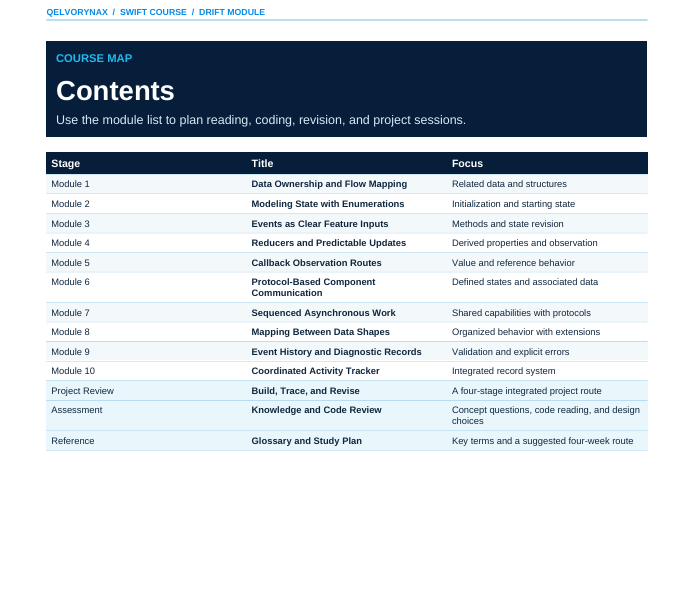
The course begins with a detailed review of data flow. Learners examine where information originates, how it changes, and which component should control each update. Examples compare scattered state changes with a central state structure that records clear values and actions.
A module on state modeling introduces defined states for inactive, loading, populated, empty, and failed conditions. Learners use enumeration structures to represent each stage and attach related data when required. Exercises demonstrate how clear states can replace several unrelated true-or-false values.
The event-handling section explores how user actions, data updates, and completed tasks can be represented as events. Learners create event types, route them to selected handlers, and separate event definitions from response logic. The materials also examine how several events may lead to the same state update.
Drift Module then covers observation patterns. Learners study how one component can respond when another component changes a value or completes an action. Practice tasks include callbacks, stored handlers, and protocol-based communication. Attention is given to avoiding unnecessary connections between unrelated components.
A dedicated section examines sequences of asynchronous actions. Learners coordinate tasks that must occur in a defined order, tasks that can run independently, and tasks that may be cancelled. Examples include loading stored records, validating entries, processing changes, and returning structured outcomes.
The course also explores data mapping and transformation between internal models and display-ready structures. Learners create focused mapping functions that format text, group records, calculate summaries, and handle missing values. These exercises demonstrate how presentation-related formatting can remain separate from core data rules.
Another module covers event history and debugging notes. Learners record selected actions, state transitions, and errors in a structured format. This creates a clearer view of how information moved through the project and where an unexpected value first appeared.
The final project involves a coordinated activity tracker. Learners define events, model states, process delayed tasks, map stored information, and connect several components through focused communication methods. The review section examines state clarity, repeated logic, dependency boundaries, and event flow.
4. Who Is This For?
Drift Module is intended for learners who already understand custom data models, protocols, closures, generics, asynchronous tasks, and structured error handling. It suits learners who want to study changing data, event-driven logic, and coordinated component behavior. The course also supports those reviewing how larger coding projects manage shared information.
5. What You’ll Learn
- Trace information through connected components
- Model loading, empty, completed, and failed states
- Define and process structured events
- Separate events from response logic
- Use callbacks and protocols for communication
- Coordinate ordered asynchronous tasks
- Handle task cancellation and failed operations
- Map internal data into display-ready structures
- Keep formatting separate from data rules
- Record event history and state transitions
- Reduce repeated update logic
- Review component connections and data ownership
6. 30-Day Refund Policy
Refund requests for Drift Module may be submitted within 30 days of purchase. Requests are reviewed according to the conditions displayed in the store’s refund policy. Learners should review those conditions before placing an order and contact the support team when clarification is needed.
Self-paced learning overview
- 📘 Digital file available after purchase
- ♾️ Long-term availability
- 🔒 Secure checkout
- 🗓️ Content updated in 2026
How are the courses structured?
How are the courses structured?
Each course is divided into focused modules that introduce concepts in a logical order. Learners move through explanations, examples, practice tasks, and review sections. The structure varies by tier, with later tiers covering broader topics and more detailed exercises.
Do I need previous coding knowledge?
Do I need previous coding knowledge?
The starting tiers are intended for learners who are new to Swift or have only explored a few basic concepts. Higher tiers are suited to learners who already understand syntax, variables, functions, and common code structures. Each course description explains the recommended learning stage.
What materials are included?
What materials are included?
Depending on the selected tier, materials may include written lessons, code examples, guided exercises, project briefs, reference notes, review questions, and downloadable study resources. Every tier follows its own learning scope and module structure.