Qelvorynax
Echo Collection
Echo Collection
Couldn't load pickup availability
Share
1. Problem Statement
Large Swift projects often contain repeated patterns across several features. Similar validation rules, state containers, data requests, and formatting methods may appear in different areas. When each feature is built in isolation, shared behavior can become inconsistent and difficult to update. Changes may require edits across many files, increasing the chance of overlooked details. Learners need a structured method for creating reusable systems without tightly connecting unrelated features.
2. Solution
Echo Collection introduces reusable architectural patterns that can support several feature areas. Learners examine how shared components, protocols, utilities, and testing boundaries can be planned before implementation. Each module combines written explanations, focused code examples, design exercises, and review tasks. The course places particular attention on balancing reuse with clear feature ownership. A final project brings several coordinated modules together within one structured codebase.
3. What’s Inside
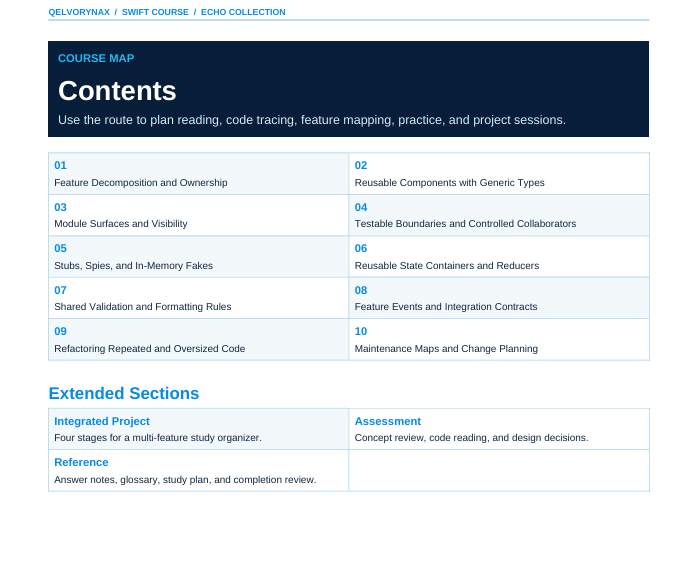
The opening module focuses on feature decomposition. Learners examine a broad project brief and divide it into smaller feature areas, shared services, data structures, and supporting utilities. Planning worksheets help define what belongs inside each feature and what may be shared across the wider project.
A module on reusable components explores generic containers, shared validation tools, formatting helpers, and protocol-based services. Learners compare useful reuse with unnecessary abstraction. Exercises encourage creating shared code only when several features have a clear and repeated need.
Echo Collection then introduces package-style organization. Learners group related files, models, rules, and services into clearly named units. The lessons examine dependency direction, public boundaries, internal behavior, and methods for preventing unrelated areas from relying on implementation details.
The testing section covers isolated checks for functions, models, services, repositories, and state transitions. Learners create replaceable test dependencies and controlled sample data. Practical tasks include checking valid outcomes, invalid entries, missing records, delayed operations, and error responses.
A dedicated module examines test doubles, including simple substitutes, recorded calls, and predefined responses. Learners use these tools to evaluate one component without depending on live storage or external data. The materials explain how clear dependency boundaries make isolated testing more practical.
The course also covers reusable state containers. Learners create defined actions, state values, and update rules that can be adapted across several features. Examples include record lists, filtered collections, progress views, and editable forms.
Another section explores code maintenance. Learners identify repeated logic, unclear naming, oversized components, and unused dependencies. Guided refactoring tasks demonstrate how to move responsibilities, simplify conditions, divide long functions, and document architectural decisions.
The final project involves a multi-feature study organizer. Learners create separate modules for topics, notes, schedules, and review records. Shared validation, storage boundaries, reusable state patterns, and testing structures connect the system without removing feature ownership. A closing review examines reuse, dependency direction, test structure, naming, and future revision needs.
4. Who Is This For?
Echo Collection is intended for learners who already understand modular architecture, repositories, dependency injection, mapping, asynchronous operations, and state management. It suits learners who want to organise several related features within one codebase. The course may also support those studying reusable systems, isolated testing, refactoring, and code maintenance.
5. What You’ll Learn
- Divide broad requirements into focused feature modules
- Identify suitable opportunities for shared code
- Create reusable generic components
- Define clear internal and external boundaries
- Organize files into structured feature units
- Build replaceable testing dependencies
- Check services, models, and state transitions
- Use controlled sample data in isolated checks
- Create reusable actions and state containers
- Refactor repeated or oversized code sections
- Document structural decisions clearly
- Coordinate several features within one project
6. 30-Day Refund Policy
Refund requests for Echo Collection may be submitted within 30 days of purchase. Each request is reviewed according to the conditions stated in the store’s refund policy. Learners should read those conditions before placing an order and contact the support team when further information is required.
Self-paced learning overview
- 📘 Digital file available after purchase
- ♾️ Long-term availability
- 🔒 Secure checkout
- 🗓️ Content updated in 2026
How are the courses structured?
How are the courses structured?
Each course is divided into focused modules that introduce concepts in a logical order. Learners move through explanations, examples, practice tasks, and review sections. The structure varies by tier, with later tiers covering broader topics and more detailed exercises.
Do I need previous coding knowledge?
Do I need previous coding knowledge?
The starting tiers are intended for learners who are new to Swift or have only explored a few basic concepts. Higher tiers are suited to learners who already understand syntax, variables, functions, and common code structures. Each course description explains the recommended learning stage.
What materials are included?
What materials are included?
Depending on the selected tier, materials may include written lessons, code examples, guided exercises, project briefs, reference notes, review questions, and downloadable study resources. Every tier follows its own learning scope and module structure.