Qelvorynax
Halo Blueprint
Halo Blueprint
Couldn't load pickup availability
Share
1. Problem Statement
As coding projects expand, responsibilities can become mixed across models, data handlers, interface logic, and supporting services. Components may depend directly on one another, making changes difficult to plan and review. Repeated data rules can appear in several areas, while a small adjustment may require edits across many files. Testing separate parts can also become difficult when each component creates its own dependencies. Learners need a structured architectural approach that keeps responsibilities clear and communication predictable.
2. Solution
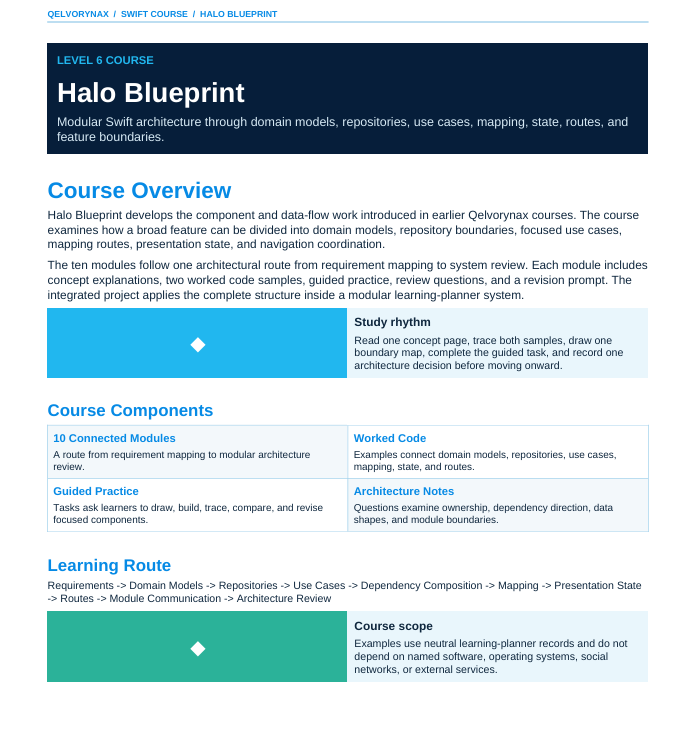
Halo Blueprint introduces layered architecture through practical Swift examples and guided design exercises. The course explains how to separate data models, application rules, storage behavior, communication services, and presentation-related logic. Learners create boundaries between components using protocols, dependency injection, mapping structures, and focused interfaces. Each module includes planning activities that encourage learners to define responsibilities before writing code. The final course project connects these methods within a modular information-management system.
3. What’s Inside
The course begins with architectural planning and responsibility mapping. Learners examine a project brief, identify its main features, and divide the required behavior into focused components. Diagrams and written planning prompts help clarify which section owns each type of data and action.
A module on layered structure introduces separate areas for data representation, application rules, storage operations, and presentation preparation. Learners compare tightly connected code with a layered arrangement where each section has a defined role. Exercises involve moving misplaced responsibilities into suitable components.
The domain modeling section explores how project rules can be represented independently from storage or display details. Learners define entities, value types, validation rules, and actions connected to the central subject of a project. Examples include scheduled records, grouped notes, learning plans, and structured task histories.
Halo Blueprint then covers repository patterns. Learners create protocol-based boundaries between application logic and stored information. Several storage approaches can follow the same requirements, allowing the surrounding code to remain focused on data requests rather than implementation details.
The service layer module introduces components responsible for coordinating several actions. Learners design services that validate information, request stored records, apply rules, and return structured outcomes. Tasks focus on keeping these services focused rather than turning them into large containers for unrelated logic.
A dedicated section examines dependency injection in larger systems. Learners pass repositories, validators, formatters, and task coordinators into the components that require them. Examples demonstrate constructor-based injection and protocol-based dependency definitions.
The mapping module explains how data can move between storage models, domain structures, and presentation-ready formats. Learners create dedicated mappers and examine why each layer may require a different representation of the same information.
The course also introduces coordinated navigation logic without connecting it directly to individual content components. Learners create route definitions, destination states, and focused coordinators that manage transitions between related sections.
The final project involves planning and building a modular learning-record system. Learners define architectural layers, create repository boundaries, model domain rules, inject dependencies, map data, and coordinate task states. A closing architecture review examines responsibility placement, dependency direction, naming, duplication, and component size.
4. Who Is This For?
Halo Blueprint is intended for learners who already understand Swift data models, protocols, generics, closures, asynchronous operations, state management, and event-driven communication. It suits learners who want to organize larger projects through modular architecture and clearly defined responsibilities. The course may also support learners reviewing dependency boundaries, repository patterns, mapping, and service coordination.
5. What You’ll Learn
- Plan project architecture before implementation
- Divide code into focused responsibility layers
- Create domain entities and value types
- Separate project rules from storage details
- Define repository boundaries with protocols
- Coordinate actions through focused services
- Inject dependencies into related components
- Map data between architectural layers
- Represent navigation routes and destination states
- Reduce direct connections between components
- Review dependency direction and component size
- Build a modular information-management project
6. 30-Day Refund Policy
Refund requests for Halo Blueprint may be submitted within 30 days of purchase. Each request is reviewed according to the conditions published in the store’s refund policy. Learners should read those conditions before placing an order and contact the support team when clarification is required.
Self-paced learning overview
- 📘 Digital file available after purchase
- ♾️ Long-term availability
- 🔒 Secure checkout
- 🗓️ Content updated in 2026
How are the courses structured?
How are the courses structured?
Each course is divided into focused modules that introduce concepts in a logical order. Learners move through explanations, examples, practice tasks, and review sections. The structure varies by tier, with later tiers covering broader topics and more detailed exercises.
Do I need previous coding knowledge?
Do I need previous coding knowledge?
The starting tiers are intended for learners who are new to Swift or have only explored a few basic concepts. Higher tiers are suited to learners who already understand syntax, variables, functions, and common code structures. Each course description explains the recommended learning stage.
What materials are included?
What materials are included?
Depending on the selected tier, materials may include written lessons, code examples, guided exercises, project briefs, reference notes, review questions, and downloadable study resources. Every tier follows its own learning scope and module structure.