Qelvorynax
Lattice Guide
Lattice Guide
Couldn't load pickup availability
Share
1. Problem Statement
Learners often understand individual coding terms but find it harder to combine them within one complete task. Variables, conditions, loops, functions, and collections may seem clear when studied separately, yet their relationship can become confusing during practical work. Without guided examples, learners may repeat code, choose unsuitable structures, or lose track of how information moves through a program. Small errors in naming, logic, or organization can also make code difficult to review. A structured course can help learners connect these ideas and apply them with greater consistency.
2. Solution
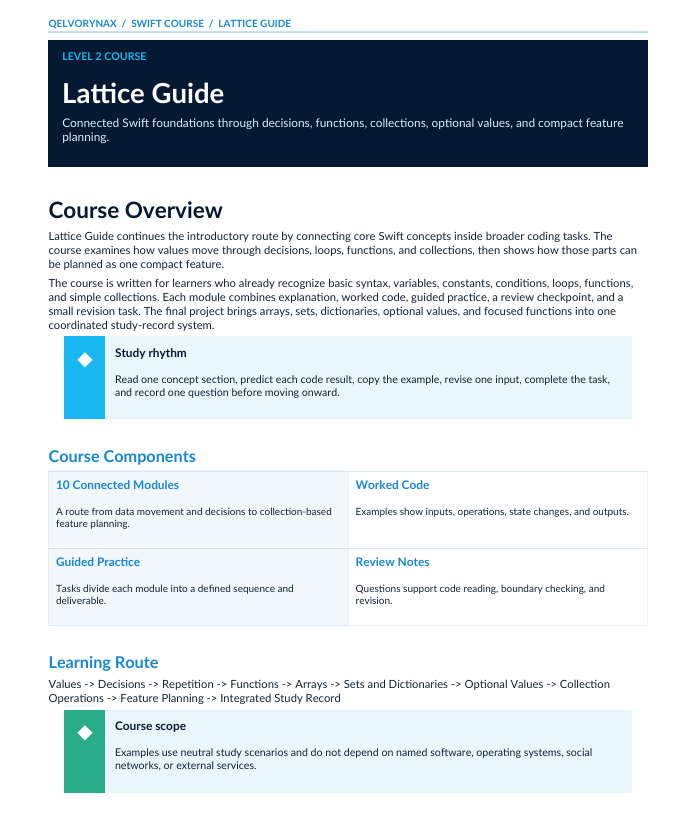
Lattice Guide presents core Swift topics as parts of one connected coding system. Each module introduces a concept, demonstrates its role, and follows it with a guided exercise. Learners examine how values move between conditions, loops, functions, and collections. Practice tasks encourage planning before writing code and reviewing the result afterward. The course supports a gradual move from isolated examples toward compact, organized coding tasks.
3. What’s Inside
The course begins with a detailed review of variables, constants, and data types. Learners examine how values are declared, updated, compared, and passed between different parts of a code block. The lessons also cover naming patterns and explain how clear names can make code easier to read and maintain.
A module on conditional logic explores several ways to direct code based on values and rules. Learners work with single conditions, combined conditions, and several possible outcomes. Guided examples show how to reduce unnecessary repetition and arrange decision paths in a readable form.
The loop section introduces repeated processing in greater detail. Learners explore how to move through ranges and collections, apply conditions during repetition, and stop or skip selected actions when needed. Exercises include counting tasks, value filtering, and simple data summaries.
Functions form a central part of the course. Learners study parameters, returned values, local values, and reusable instructions. The materials explain how a larger task can be divided into smaller functions, each with a clear purpose. Practice activities involve creating functions for calculations, text handling, and value comparison.
The collections module covers arrays, sets, and dictionaries. Learners compare their structures and explore when each one may be useful. Examples demonstrate adding, removing, updating, sorting, and searching for stored values. Several tasks combine collections with loops and conditions.
Lattice Guide also introduces optional values. Learners examine why some values may be absent and how to handle that possibility carefully. Written examples show several methods for checking, unwrapping, and using optional values without disrupting the surrounding logic.
The closing section brings the modules together in a guided mini-project. Learners plan a small information tracker, divide the task into functions, select suitable collections, and apply conditions to process stored data. Review notes encourage learners to examine code clarity, repeated logic, and possible adjustments.
4. Who Is This For?
Lattice Guide is intended for learners who understand basic Swift syntax and want to develop a more connected view of core coding structures. It suits students moving beyond introductory exercises, self-directed learners who prefer organized materials, and anyone wishing to practise combining several concepts within one task. It may also be useful as a structured review for learners returning to Swift after a study break.
5. What You’ll Learn
- Organize variables and constants with clear naming
- Build decision paths with conditional statements
- Combine several logical conditions
- Use loops with ranges and collections
- Create functions with parameters and returned values
- Divide larger tasks into smaller code sections
- Compare arrays, sets, and dictionaries
- Update, sort, search, and filter stored values
- Handle optional values carefully
- Combine functions, loops, conditions, and collections
- Plan a compact coding task before writing it
- Review code for repetition and clarity
6. 30-Day Refund Policy
Refund requests for Lattice Guide may be submitted within 30 days of purchase. Each request is reviewed according to the terms displayed in the store’s refund policy. Learners should read the policy before completing an order and contact the support team with any questions regarding eligibility or the review process.
Self-paced learning overview
- 📘 Digital file available after purchase
- ♾️ Long-term availability
- 🔒 Secure checkout
- 🗓️ Content updated in 2026
How are the courses structured?
How are the courses structured?
Each course is divided into focused modules that introduce concepts in a logical order. Learners move through explanations, examples, practice tasks, and review sections. The structure varies by tier, with later tiers covering broader topics and more detailed exercises.
Do I need previous coding knowledge?
Do I need previous coding knowledge?
The starting tiers are intended for learners who are new to Swift or have only explored a few basic concepts. Higher tiers are suited to learners who already understand syntax, variables, functions, and common code structures. Each course description explains the recommended learning stage.
What materials are included?
What materials are included?
Depending on the selected tier, materials may include written lessons, code examples, guided exercises, project briefs, reference notes, review questions, and downloadable study resources. Every tier follows its own learning scope and module structure.