Qelvorynax
Neon Framework
Neon Framework
Couldn't load pickup availability
Share
1. Problem Statement
Learners may understand functions, collections, loops, and conditions but still find it difficult to organize them within a larger project. Code can become repetitive when related responsibilities are placed inside one long section. Data may also be stored inconsistently, making it difficult to track how values move between different parts of a task. Without a clear structure, even a small change can affect several unrelated sections. Learners therefore need a guided way to divide code into focused and reusable components.
2. Solution
Neon Framework introduces methods for organizing Swift code around clear responsibilities. Each module explains how related values and actions can be grouped into logical structures. Learners work through examples that move from simple data models toward connected components. Guided exercises encourage code planning, naming review, and separation of repeated logic. The course helps learners develop a structured approach to building and revising larger coding tasks.
3. What’s Inside
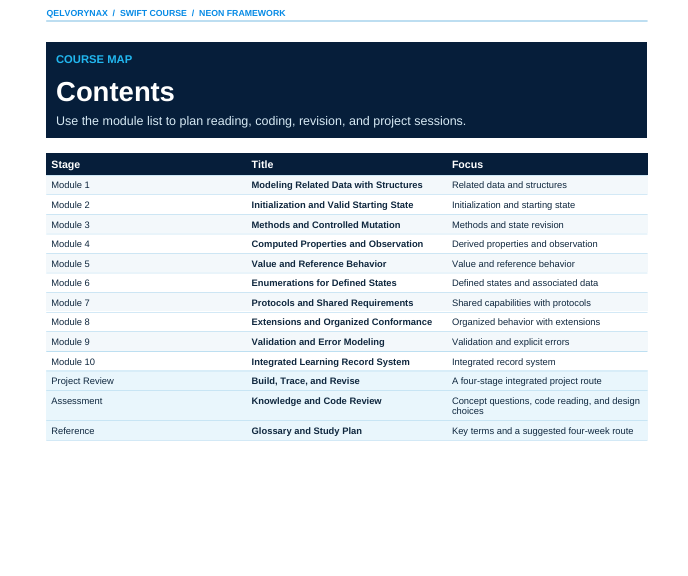
The opening module reviews functions, parameters, returned values, and variable scope. Learners examine how information enters a function, how it is processed, and how the result is passed to another section. Exercises focus on reducing repeated instructions and giving each function one clear responsibility.
The next module introduces custom data structures. Learners explore how related properties can be grouped and how methods can describe actions connected to that data. Examples include profile records, task entries, catalogue items, and progress notes. The lessons also cover initial values and controlled property updates.
A dedicated section examines value-based and reference-based behavior. Learners compare how different structures are copied, shared, and updated. Practical tasks demonstrate why the chosen structure can affect how information changes across a project.
The course then explores computed properties and property observers. Learners see how a value can be calculated from other stored information and how selected actions can occur when a property changes. Exercises include totals, status labels, formatted summaries, and validation checks.
Neon Framework also covers enumeration structures for representing a defined group of states or choices. Learners use them to organize categories, progress stages, directions, and task conditions. Associated information is introduced through focused examples that connect each case with additional data.
Another module introduces protocols as a way to describe shared requirements. Learners examine how several structures can follow the same set of properties or methods while keeping their own internal behavior. Examples show how this approach can make code more consistent and easier to extend.
Error handling is presented through practical scenarios involving missing values, invalid entries, and unsupported operations. Learners practise defining errors, identifying where they may occur, and responding with clear alternative paths.
The closing project brings these topics together in a structured record-management task. Learners create custom models, organize states, apply shared requirements, validate data, and divide actions into focused functions. A review checklist supports reflection on naming, repetition, structure, and code readability.
4. Who Is This For?
Neon Framework is intended for learners who are comfortable with Swift syntax, functions, collections, conditions, loops, and optional values. It suits learners who want to move from short exercises toward larger, connected coding tasks. The course may also support those revisiting code organization, custom structures, data modeling, and reusable components.
5. What You’ll Learn
- Divide larger tasks into focused functions
- Manage parameters, returned values, and variable scope
- Create custom structures for related data
- Define properties, methods, and initial values
- Compare value-based and reference-based behavior
- Use computed properties and property observers
- Represent states with enumeration structures
- Attach related information to defined cases
- Describe shared requirements with protocols
- Handle invalid data and coding errors
- Reduce repeated logic across several components
- Plan and review a structured coding project
6. 30-Day Refund Policy
Refund requests for Neon Framework may be submitted within 30 days of purchase. Requests are reviewed according to the conditions stated in the store’s refund policy. Learners should read the policy before placing an order and contact the support team when clarification is needed.
Self-paced learning overview
- 📘 Digital file available after purchase
- ♾️ Long-term availability
- 🔒 Secure checkout
- 🗓️ Content updated in 2026
How are the courses structured?
How are the courses structured?
Each course is divided into focused modules that introduce concepts in a logical order. Learners move through explanations, examples, practice tasks, and review sections. The structure varies by tier, with later tiers covering broader topics and more detailed exercises.
Do I need previous coding knowledge?
Do I need previous coding knowledge?
The starting tiers are intended for learners who are new to Swift or have only explored a few basic concepts. Higher tiers are suited to learners who already understand syntax, variables, functions, and common code structures. Each course description explains the recommended learning stage.
What materials are included?
What materials are included?
Depending on the selected tier, materials may include written lessons, code examples, guided exercises, project briefs, reference notes, review questions, and downloadable study resources. Every tier follows its own learning scope and module structure.