Qelvorynax
Quantum Series
Quantum Series
Couldn't load pickup availability
Share
1. Problem Statement
Complex Swift projects may contain several modules that exchange data, react to events, and perform delayed operations. When these relationships are not documented clearly, tracing the source of an error can become difficult. A failed task may also affect several connected components when recovery paths are not defined. Testing becomes harder when behavior depends on timing, stored information, and multiple services. Learners need a structured approach for designing systems that remain understandable during change, interruption, and revision.
2. Solution
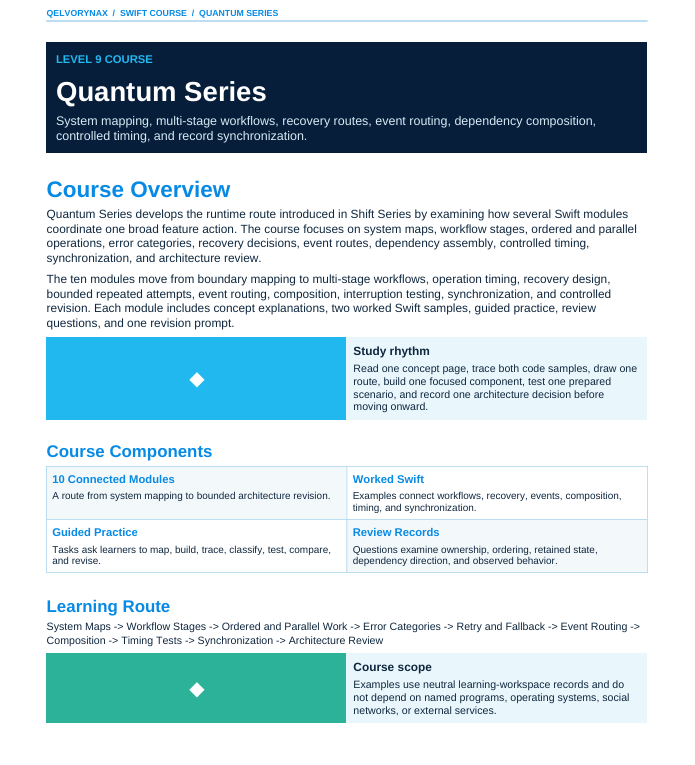
Quantum Series presents architectural methods for coordinating complex workflows across separate Swift components. Learners examine how task boundaries, event routes, recovery rules, and data ownership can be defined before implementation. Each module combines system diagrams, written explanations, coding exercises, and review activities. The materials also introduce advanced testing scenarios involving delayed responses, interrupted operations, and partial data. The final project brings these concepts together within a multi-module information platform.
3. What’s Inside
The opening module focuses on system mapping. Learners document components, dependencies, state ownership, event routes, and data boundaries. Planning exercises demonstrate how diagrams can reveal unclear responsibilities and unnecessary connections before code is revised.
A module on workflow coordination examines tasks that involve several stages. Learners define input, validation, processing, storage, and output steps as separate operations. Exercises cover ordered workflows, parallel tasks, cancellation rules, and partial completion states.
Quantum Series then explores resilient error handling. Learners group errors by source, severity, and possible response. Examples demonstrate retry rules, fallback data, delayed recovery, user-facing messages, and internal diagnostic records. Attention is given to preventing repeated retries and unclear recovery loops.
The event-routing section introduces structured communication across several modules. Learners define event types, route actions through focused coordinators, and record state changes. Practice tasks show how event history can support debugging and system review.
A dedicated module covers advanced dependency composition. Learners assemble repositories, validators, task coordinators, state containers, and formatters at a defined composition point. This keeps creation logic separate from feature behavior and supports controlled testing arrangements.
The testing section includes workflow checks, state transition checks, repository checks, timing scenarios, cancellation paths, and recovery behavior. Learners create controlled responses and simulated delays to study how a system behaves under different conditions.
Quantum Series also examines data synchronization. Learners compare local records with updated data, resolve conflicts, identify outdated values, and define refresh rules. Exercises involve timestamps, change markers, merge decisions, and structured update summaries.
Another section focuses on architectural review. Learners evaluate dependency direction, module size, state ownership, repeated behavior, and unclear boundaries. Guided refactoring tasks support gradual revisions without changing several areas at once.
The closing project involves a multi-module learning workspace. Learners coordinate records, schedules, notes, progress states, delayed tasks, synchronization, and error recovery. A final system review covers workflow clarity, test coverage, recovery paths, event history, and data consistency.
4. Who Is This For?
Quantum Series is intended for learners who are comfortable with modular architecture, concurrency, persistence, testing, state management, dependency injection, and event-driven systems. It suits learners who want to examine complex workflows and coordinated feature behavior. The course may also support those reviewing recovery design, synchronization, system testing, and architectural documentation.
5. What You’ll Learn
- Map components, dependencies, and data boundaries
- Design workflows with several connected stages
- Coordinate parallel and ordered operations
- Define cancellation and recovery behavior
- Organize errors by source and response
- Create retry and fallback rules
- Route events across separate modules
- Assemble dependencies at a composition point
- Test timing, interruption, and recovery scenarios
- Synchronize local and updated records
- Resolve conflicting data changes
- Review and revise complex architecture
6. 30-Day Refund Policy
Refund requests for Quantum Series may be submitted within 30 days of purchase. Each request is reviewed according to the conditions published in the store’s refund policy. Learners should review those conditions before placing an order and contact the support team when further clarification is required.
Self-paced learning overview
- 📘 Digital file available after purchase
- ♾️ Long-term availability
- 🔒 Secure checkout
- 🗓️ Content updated in 2026
How are the courses structured?
How are the courses structured?
Each course is divided into focused modules that introduce concepts in a logical order. Learners move through explanations, examples, practice tasks, and review sections. The structure varies by tier, with later tiers covering broader topics and more detailed exercises.
Do I need previous coding knowledge?
Do I need previous coding knowledge?
The starting tiers are intended for learners who are new to Swift or have only explored a few basic concepts. Higher tiers are suited to learners who already understand syntax, variables, functions, and common code structures. Each course description explains the recommended learning stage.
What materials are included?
What materials are included?
Depending on the selected tier, materials may include written lessons, code examples, guided exercises, project briefs, reference notes, review questions, and downloadable study resources. Every tier follows its own learning scope and module structure.