Qelvorynax
Shift Series
Shift Series
Couldn't load pickup availability
Share
1. Problem Statement
A well-organized codebase can still become difficult to maintain when several tasks run at the same time. Data may be read, changed, or saved by different components, creating inconsistent results when operations are not coordinated. Long-running work can affect responsiveness, while retained references may consume resources after they are no longer needed. Performance concerns can also be difficult to locate when measurement and diagnostic steps are missing. Learners need a structured way to examine timing, memory, persistence, and resource use across connected Swift components.
2. Solution
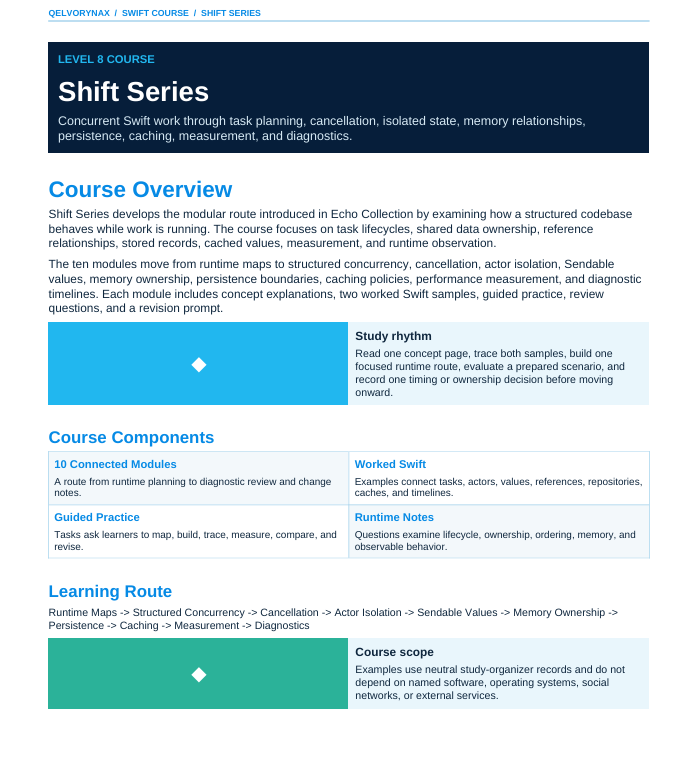
Shift Series presents these topics through focused modules that connect architecture with runtime behavior. Learners examine how tasks begin, communicate, pause, finish, and respond to cancellation. The course introduces methods for managing shared data, reviewing reference relationships, and separating persistence from project rules. Practical exercises encourage measurement before revision rather than relying on assumptions. The closing project combines concurrent operations, stored records, diagnostics, and performance review within one coordinated system.
3. What’s Inside
The opening module introduces concurrent task planning. Learners identify which operations must happen in order, which can proceed independently, and which should stop when their result is no longer needed. Exercises include grouped tasks, task cancellation, structured outcomes, and coordinated state updates.
A section on shared data examines what can happen when several operations read or change the same value. Learners create clear ownership rules and controlled update points. Examples demonstrate how isolated state containers can reduce unexpected changes and make data flow easier to trace.
Shift Series then explores memory behavior. Learners review value storage, shared references, retained relationships, and object lifecycles. Guided tasks focus on identifying reference cycles, selecting suitable ownership relationships, and removing stored handlers when they are no longer required.
The persistence module separates stored data from internal project models. Learners define repository requirements, storage records, mapping rules, and update operations. Exercises cover creating, reading, revising, removing, sorting, and filtering stored entries while keeping persistence details outside central project rules.
A dedicated section examines caching and temporary data. Learners decide which values may be reused, when stored results become outdated, and how refreshed information should replace earlier values. Examples include record summaries, calculated totals, filtered lists, and recently requested information.
The performance review module introduces measurement-based revision. Learners compare operation duration, repeated calculations, collection processing, and unnecessary data mapping. Activities demonstrate how to record observations, adjust one area at a time, and compare the result after each revision.
Diagnostics are covered through structured event records, error categories, task timelines, and state histories. Learners create useful internal records that show what occurred without mixing diagnostic details with learner-facing messages.
The final project involves a synchronized record workspace. Learners coordinate several tasks, store and retrieve information, apply caching rules, manage shared state, inspect reference relationships, and record diagnostic events. A final review examines timing, memory use, persistence boundaries, cancellation paths, and data consistency.
4. Who Is This For?
Shift Series is intended for learners with experience in modular architecture, state management, asynchronous operations, dependency injection, repositories, testing, and reusable components. It suits learners who want to study how larger Swift systems behave while running. The course may also support those reviewing memory relationships, persistence design, concurrent tasks, caching, and performance measurement.
5. What You’ll Learn
- Plan ordered and independent concurrent tasks
- Coordinate cancellation and structured outcomes
- Manage shared data through clear ownership rules
- Review value storage and reference relationships
- Identify and remove reference cycles
- Separate persistence from internal project rules
- Map stored records into project models
- Create caching and refresh rules
- Measure operation duration and repeated work
- Revise collection processing and data mapping
- Record task timelines and state histories
- Build a synchronized record-management project
6. 30-Day Refund Policy
Refund requests for Shift Series may be submitted within 30 days of purchase. Each request is reviewed according to the conditions published in the store’s refund policy. Learners should read those conditions before placing an order and contact the support team when additional information is needed.
Self-paced learning overview
- 📘 Digital file available after purchase
- ♾️ Long-term availability
- 🔒 Secure checkout
- 🗓️ Content updated in 2026
How are the courses structured?
How are the courses structured?
Each course is divided into focused modules that introduce concepts in a logical order. Learners move through explanations, examples, practice tasks, and review sections. The structure varies by tier, with later tiers covering broader topics and more detailed exercises.
Do I need previous coding knowledge?
Do I need previous coding knowledge?
The starting tiers are intended for learners who are new to Swift or have only explored a few basic concepts. Higher tiers are suited to learners who already understand syntax, variables, functions, and common code structures. Each course description explains the recommended learning stage.
What materials are included?
What materials are included?
Depending on the selected tier, materials may include written lessons, code examples, guided exercises, project briefs, reference notes, review questions, and downloadable study resources. Every tier follows its own learning scope and module structure.