Qelvorynax
Vertex Series
Vertex Series
Couldn't load pickup availability
Share
1. Problem Statement
Working with a large Swift system requires more than combining separate features into one codebase. Responsibilities may overlap, dependencies may become difficult to trace, and state changes can move through several components before reaching their final destination. Testing may overlook rare timing conditions, interrupted tasks, conflicting records, or incomplete responses. Documentation can also fall behind the actual structure, making later revisions harder to plan. Learners need a complete workflow for studying architecture, implementation, testing, maintenance, and technical review as connected activities.
2. Solution
Vertex Series presents a full project workflow built around planning, implementation, observation, and revision. Each module focuses on a distinct stage, from interpreting requirements to reviewing the completed architecture. Learners create diagrams, responsibility maps, data models, dependency boundaries, test scenarios, and diagnostic records. Practical tasks encourage careful reasoning before code changes are made. The final assignment combines the course topics within a multi-feature Swift system supported by structured documentation.
3. What’s Inside
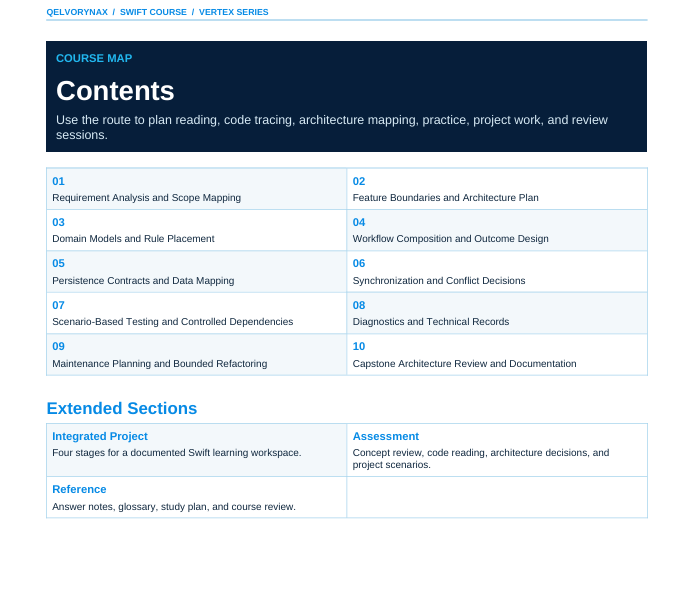
The opening module focuses on requirement analysis. Learners examine a detailed project brief, separate functional needs from technical constraints, and identify the main data groups, actions, states, and possible errors. Planning worksheets help convert broad requirements into smaller implementation tasks.
The architectural design section covers feature boundaries, dependency direction, state ownership, repository requirements, service responsibilities, and communication routes. Learners create diagrams that show how information enters, moves through, and leaves each area of the system.
A domain modeling module examines entities, value structures, validation rules, state definitions, and business-related actions. Learners practise keeping central rules separate from storage formats, display preparation, and communication details.
Vertex Series then explores workflow composition. Learners coordinate validation, retrieval, processing, persistence, synchronization, and result preparation as separate stages. Exercises include sequential actions, concurrent operations, cancellation paths, partial outcomes, and recovery procedures.
The persistence and synchronization section covers stored records, model mapping, timestamps, change tracking, conflict handling, caching, and refresh rules. Learners compare several record versions and define how the system should respond when information differs.
A broad testing module includes isolated component checks, workflow scenarios, state transitions, repository behavior, delayed responses, cancellation, invalid values, and recovery paths. Learners build controlled dependencies that return predefined data and record received requests.
The diagnostics section introduces structured event histories, categorized errors, operation timelines, and state-change records. Learners use these records to trace unexpected behavior without placing diagnostic logic throughout unrelated components.
Another module focuses on maintenance planning. Learners identify repeated logic, unused dependencies, unclear naming, oversized sections, and outdated documentation. Refactoring activities are divided into small stages so each revision can be reviewed separately.
The final assignment involves designing a multi-feature learning organizer. Learners coordinate topic records, schedules, notes, review history, stored data, delayed tasks, synchronization, and error responses. The completed work includes architecture diagrams, test notes, dependency maps, diagnostic records, and a written revision plan.
4. Who Is This For?
Vertex Series is intended for learners who already understand Swift architecture, concurrency, persistence, testing, state coordination, dependency injection, synchronization, and event-based communication. It suits learners who want to connect these areas within one extensive project. The course may also support developers reviewing established codebases and documenting structural decisions.
5. What You’ll Learn
- Convert broad requirements into implementation stages
- Map features, dependencies, states, and data routes
- Define clear ownership for information and actions
- Separate central rules from storage and presentation details
- Compose workflows from focused operations
- Coordinate sequential and concurrent tasks
- Define cancellation, recovery, and partial outcomes
- Design persistence and synchronization rules
- Create controlled testing dependencies
- Examine timing and interruption scenarios
- Build structured diagnostic records
- Prepare architecture and maintenance documentation
- Review repeated logic and unclear boundaries
- Complete a documented multi-feature Swift project
6. 30-Day Refund Policy
Refund requests for Vertex Series may be submitted within 30 days of purchase. Each request is reviewed under the conditions stated in the store’s published refund policy. Learners should read those conditions before placing an order and contact the support team when further information is required.
Self-paced learning overview
- 📘 Digital file available after purchase
- ♾️ Long-term availability
- 🔒 Secure checkout
- 🗓️ Content updated in 2026
How are the courses structured?
How are the courses structured?
Each course is divided into focused modules that introduce concepts in a logical order. Learners move through explanations, examples, practice tasks, and review sections. The structure varies by tier, with later tiers covering broader topics and more detailed exercises.
Do I need previous coding knowledge?
Do I need previous coding knowledge?
The starting tiers are intended for learners who are new to Swift or have only explored a few basic concepts. Higher tiers are suited to learners who already understand syntax, variables, functions, and common code structures. Each course description explains the recommended learning stage.
What materials are included?
What materials are included?
Depending on the selected tier, materials may include written lessons, code examples, guided exercises, project briefs, reference notes, review questions, and downloadable study resources. Every tier follows its own learning scope and module structure.